


You know the feeling. You open a cupboard and something falls out. You cannot find the charger or the scissors, even though you saw them yesterday. The house is not dirty — it is just full. Learning how to declutter your home does not mean throwing everything away or living like a minimalist. It means deciding, room by room, what earns its place, and giving the rest a way out.
A weekend is enough to make a real difference, but only with a plan. Set a clear finish line: not a perfect home, but a noticeably calmer one by Monday morning.
Why Clutter Builds Up So Quietly
Clutter rarely arrives all at once. A free tote bag here, a gadget you meant to return there, clothes that no longer fit but might “one day.” Each item enters with a small reason and then stays because deciding takes effort. Psychologists call this decision fatigue: after a long week, choosing what to keep feels harder than just closing the drawer.
That is why vague plans fail. “Sort out the house” is not a task, it is a mountain. A weekend plan works because it breaks the mountain into rooms, hours, and boxes — and because it ends.
The Weekend Plan at a Glance
Think of the weekend in three blocks. Friday evening is preparation: gather supplies, pick your rooms, and set the rules. Saturday is the main event: two or three rooms, worked in order, with breaks built in. Sunday is for finishing touches: the boxes leave the house, the kept things get homes, and you set up two small habits that stop the clutter coming straight back.
Do not try to do every room. Start with the one or two rooms that bother you most — often the bedroom, the living room, or the kitchen. Finishing two rooms properly feels far better than half-starting six.
Friday Evening: Set Yourself Up to Succeed
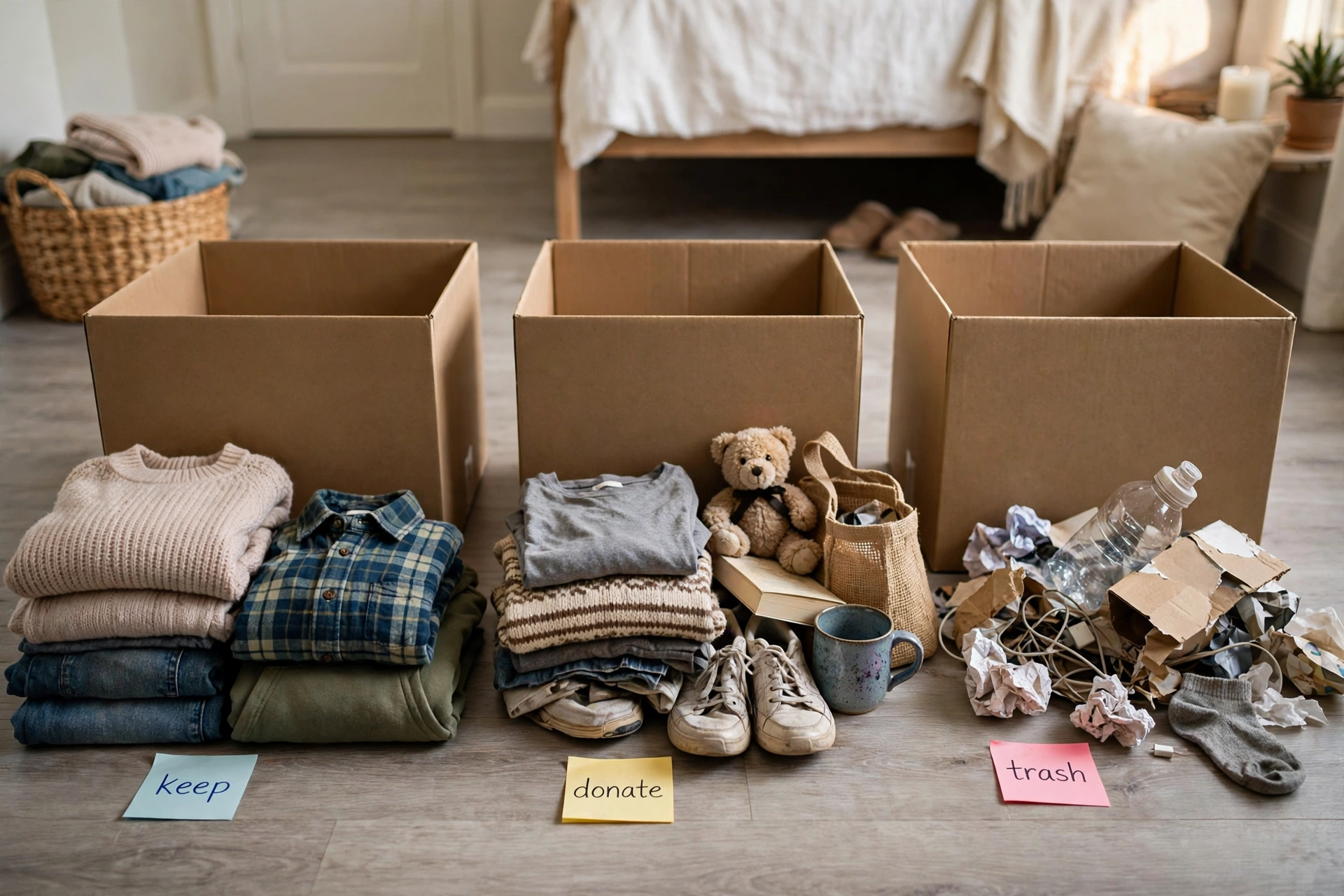
You need less equipment than you think: three sturdy boxes or bags, a rubbish bag, a marker, and a timer. Label the boxes Keep, Donate, and Trash — this is the classic three-box method, and it works because every item gets exactly one decision. No fourth box for “maybe.” If you genuinely cannot decide in ten seconds, it goes in Donate, because the hesitation usually means you do not need it.
Walk through your chosen rooms and note the worst spots: the chair covered in clothes, the drawer that will not close, the shelf of books you will never reread. That list becomes your Saturday order, worst first, so your fresh morning energy goes to what annoys you most.
Tell anyone you live with what you are doing, and agree on one rule: nobody rescues items from the Donate box without a real reason. Nothing kills momentum like re-debating every old T-shirt.
Saturday: Work Room by Room, Not Pile by Pile
Start with surfaces, because visible progress keeps you going. Clear the tops of tables, counters, and shelves first, putting each item into one of the three boxes. Then open one cupboard or drawer at a time and do the same. Working drawer by drawer stops the common mistake of pulling everything out at once and ending up with a bigger mess than you started with.
Use the timer: forty-five minutes of focused sorting, then a fifteen-minute break. After three rounds, take a proper lunch break away from the mess. People often quit not because the work is hard, but because they work for hours straight and burn out — and a tired sorter is far more likely to throw away something important.
For clothes, try a simple test: if you have not worn it in a year, and it does not fit or hold a real memory, it goes. Keep one small memory box for letters, photos, and keepsakes, with a firm limit: when it is full, something must go before anything new enters.
By Saturday evening, your Donate boxes should be sealed and by the door, not sitting in a corner “for later.” The weekend only works if the stuff actually leaves.
Sunday: Give Everything a Home
Sunday is quieter work. Put the Keep items back, but only where they belong: every kept thing gets a specific place, and that place should be easy to reach. The scissors live in one drawer, not three. Chargers live in one basket by the socket, not scattered through every room. If something has no home, that is useful information — it may not be worth keeping after all.
This is also the moment to deal with digital clutter. An overflowing phone creates the same low-level stress as a messy room. Read our guide to backing up your phone and computer before you delete anything, and clearing old downloads can even help a sluggish machine feel faster, as our guide to speeding up a slow laptop explains. Twenty minutes deleting duplicate photos, unused apps, and old downloads is a satisfying way to finish.
Finally, set two habits that protect your work. The first is a five-minute evening reset: put things back where they belong before bed, so mornings start calm. A short morning routine helps here too, because a tidy start makes the rest of the day easier. The second habit is one-in, one-out: when something new comes into the house, something old leaves. It sounds strict, but after a weekend of sorting, most people find it a relief rather than a rule.

What to Do With the Donate Box
Drop donations off on Sunday or Monday at the latest — a bag by the door has a way of creeping back into a cupboard. Charity shops welcome clean clothes, working electronics, and household goods. Broken items go to recycling, not to charity: passing on something unusable just moves your clutter into someone else’s problem.
If some things are genuinely valuable, sell them, but set a deadline. List them this week, and whatever does not sell in two weeks gets donated. The goal of the weekend was space and calm, not a second job running an online shop.
Mistakes to Avoid When You Declutter Your Home
The first mistake is starting with sentimental things. Old photos and childhood keepsakes deserve slow, unhurried decisions, not a Saturday-morning rush. Leave them for last, or for another weekend entirely.
The second mistake is buying storage before sorting. Pretty baskets and boxes feel like progress, but they mostly hide the problem. Sort first, count what is actually left, and only then buy the storage that fits it. Most people find they need far less than they expected.
The third mistake is doing it all alone. A friend or family member with a timer and a playlist makes the work faster and lighter — just agree on the rules before you start.
Frequently Asked Questions
How long does it really take to declutter your home?
One weekend is enough for two or three rooms in most homes. A whole house usually takes several weekends, and that is fine. Do the rooms that bother you most first, then schedule one room per weekend until you are done. Progress that sticks beats a heroic weekend that leaves you exhausted.
What if my family does not want to get rid of anything?
Start with your own things and shared spaces, not other people’s belongings. When family members see the calmer living room, they often join in. For shared items, agree on a simple test — “have we used this in the last year?” — and let each person keep a small personal box.
Should I declutter before or after cleaning?
Declutter first, then clean. There is no point dusting shelves full of things you are about to remove, and cleaning a freshly cleared surface is far quicker and more satisfying. Think of it as: decide, remove, then clean what remains.
How do I stop the clutter coming back?
Two habits do most of the work: the five-minute evening reset, and one-in, one-out for new purchases. Also, pause before bringing free things home — the tote bag, the extra mug, the sample. Free is not free if it costs you space and attention for years.
Final Thoughts
To declutter your home in a weekend, you do not need special skills or a perfect plan. You need three boxes, a timer, a room-by-room order, and a promise to yourself that the Donate boxes leave the house. Start Friday evening, work steadily on Saturday, finish gently on Sunday, and keep it going with a five-minute reset each night.
By Monday, you will not have a show home. You will have something better: a home where you can find things and actually relax. Pick your worst room, set the timer, and begin.